User ResearchBehavioural DesignService DesignEnterprise UXShipped · 2024

Designing Decision-Making Systems

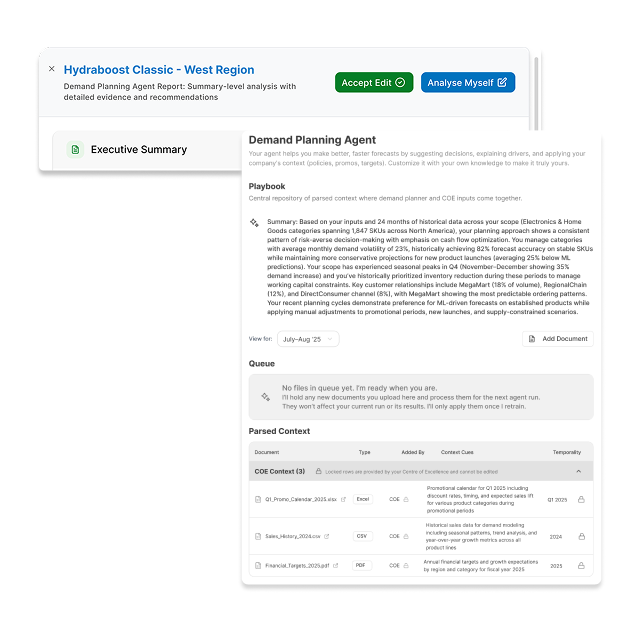
To Reduce Demand Planning From Hours → Minutes

My Role

Lead UX Researcher & Designer

Duration

Aug to Dec 2025 (5 months)

Deliverables

Research Plan and Insights, Product Design, User Experience Strategy, Strategic Vision

Team

2 Designers, 1 PM, 5 Engineers

01 — Overview / Context

What was the problem we were solving?

B2B supply chains are fast-moving, interconnected systems operating at massive scale. Demand planning means forecasting across millions of SKUs every month, and minor errors cascade quickly into empty shelves, broken supplier relationships, and lost revenue. Forecasting demand plans across hundreds of products is complex, and minor errors quickly lead to empty shelves. Our mandate was to understand where the planning process was breaking down, and design systems that meaningfully improved both decision-making speed and quality.

Key Stakeholders: Demand Planners, Prediction Models, and Inventory Management

Demand plans include millions of SKUs forecasted every month or planning cycle

Supply decisions inform stakeholders, retailers, and global branches across cycles that take weeks

02 — Research / Barriers

What did we learn from users?

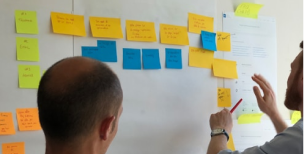
We used a systems design approach, conducting deep qualitative and contextual research to understand how decisions were actually being made, and precisely where they broke down.

14+

Interviews

100+

Minutes of observations

3

Workshops and roundtables

3

Contextual inquiries

Key Barriers Identified

Cognitive Overload + Task Fatigue

Demand Planners spend ~90% of their time on repetitive tasks with limited context, leaving almost no room for strategic thinking or high-quality decision-making.

Experience Know-How + Process Inefficiency

Planners edit demand plans relying on tacit knowledge that is hard to formalize, and resist handing off decision-making control, because the system can't reflect what they know.
Risk Aversion + Overcorrection

9/10 planners say they have to defend every update and change, but have no structured way to capture or show their logic, creating constant credibility pressure.

Availability Bias + Perceived Pattern Recognition

Planners struggle to trust statistical model recommendations they don't understand, and regularly adjust or reject forecasts based on instinct over evidence.

[ Reframe hero image — placeholder ]

03 — Reframe / How Might We

Demand planning becomes a cycle of guesswork and chair-swiveling across tools, driven by rushed timelines and limited context, despite access to advanced enterprise systems. This creates chaos and longer planning cycles in environments where speed is everything.

How Might We

How might we reduce uncertainty and activate clarity, collaboration, and confident decision-making during critical demand planning moments across all stakeholders?

Create better re-learning processesReduce cognitive overload in daily tasksIncreasing accuracy and managing context

/ New Paradigm / Solution Themes

From Chaos
To Clarity

Shift demand planning from reactive editing to focused, intentional decision-making through structured processes and relationships that reduce cognitive load and enable proactive system learning.

/ Strategic Values For Tool /

Pillar #1

Improve signal quality and reduce noise

with high-stakes decisions, while preserving agency.

Pillar #2

Make decision logic transparent

and reduce repetition, to build confidence and clarity.

Pillar #3

Embed continuous learning

and improvement mechanisms across the system, with autonomy.

Pillar #4

Enable cohesive collaboration for defensible actions

at critical moments.

[ Solution themes image — placeholder ]

04 — Interventions

What did we design to address this?

Prioritisation Design

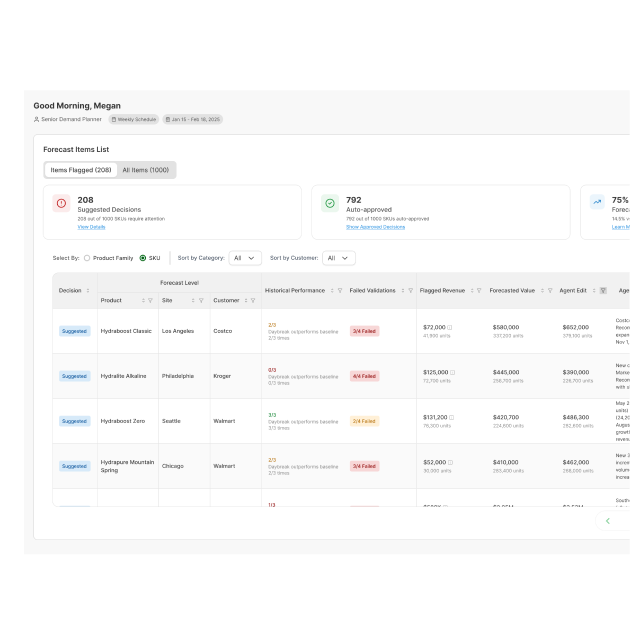
Prioritise high-impact items for the Demand Planner and reduce cognitive load

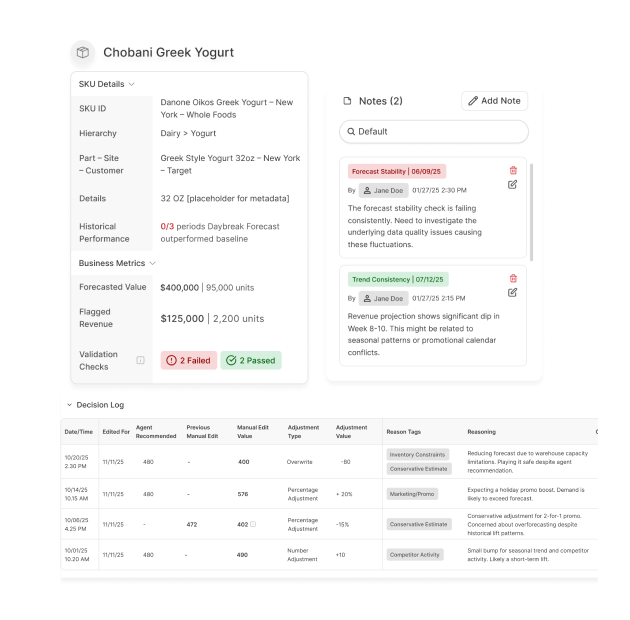
Redesigned the planning view to surface high-stakes exceptions first, reducing the volume of items reviewed manually and directing attention to the decisions that actually matter.

Automation + Explainability

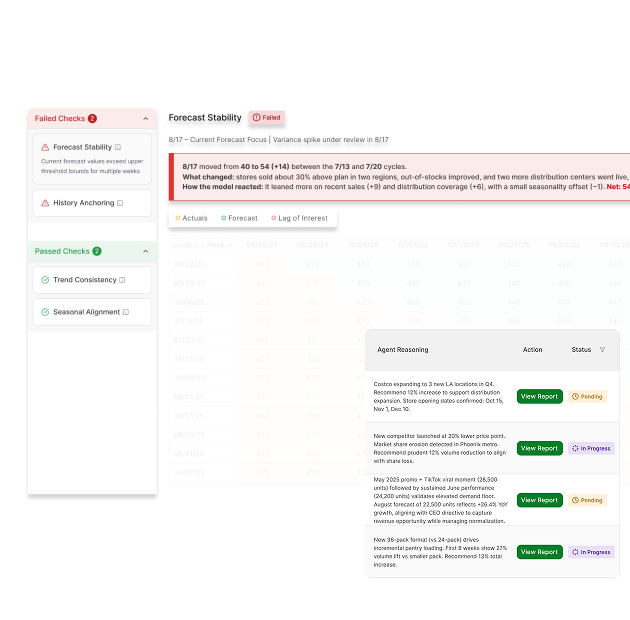
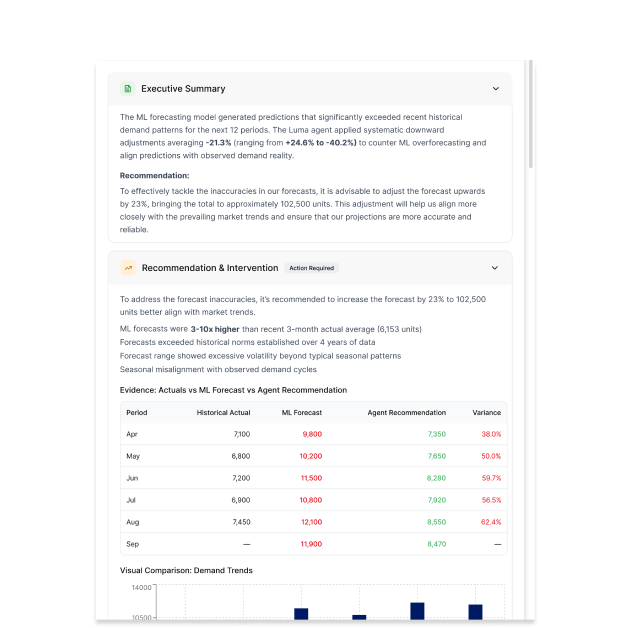
Automate repetitive items, with a focus on explainability for low-impact entry

Automated low-decision-weight items with transparent reasoning built in, so planners could trust outputs and redirect cognitive effort toward complex, high-stakes calls.

Logic Capture + System Learning

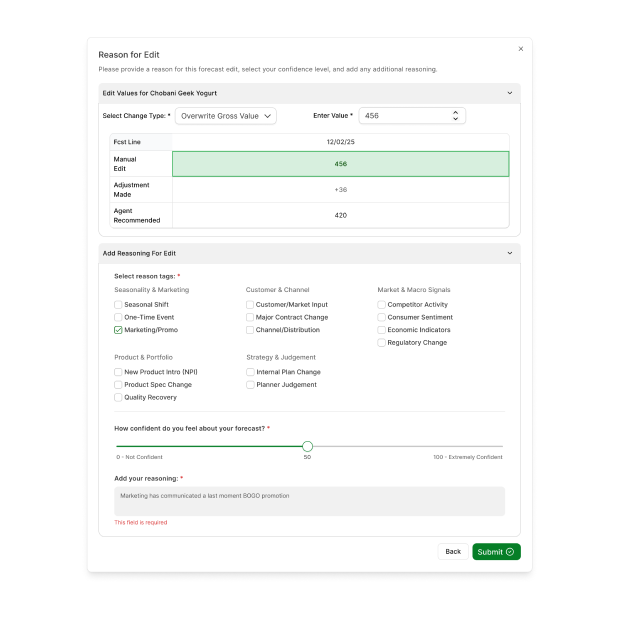
Capture exception logic and context for the system to learn and prompt for future cycles

Built a mechanism to log and encode business rules and edge cases, enabling the system to flag similar patterns in future planning cycles and reduce recurring guesswork.

Planner Agency Design

Prioritise demand planner agency and value addition on every commitment planning schedule

Designed the entire planner workflow so human judgment remains the centrepiece. The system augments and supports, it never replaces.

Information Architecture + Shared Context

Design shared context and clarity: information visibility that enables decision-making for future states

Created shared dashboards and contextual views so every stakeholder operates from the same data picture, reducing misalignment, defensibility pressure, and late-cycle surprises.

Repeatable Decision Systems

Scale decision-making logic across the system with reusable, AI-assisted architecture

Built reusable, AI-assisted design system components that embed structured service-design thinking at enterprise scale, enabling faster production and system-wide consistency across clients.

05 — Impact

What changed as a result?

Prototype securing multi-client buy-in.

70+

Screens designed across an enterprise-grade system for 3+ Clients

Across 7 core product areas, the system delivered a scalable decision architecture with out-of-the-box capabilities, prototype secured multi-client buy-in.

Decision system used in high-stakes planning.

$2.2M+

Revenue Unlocked From MVP

A defensible decision system that supported over $2M in pilot forecasted revenue and directly strengthened enterprise sales momentum.

AI-assisted design at enterprise scale.

3–5×

Design Velocity Scaled For Launch

Faster production enabled by embedding structured service-design informed system thinking through reusable, AI-assisted design system scaling.

06 — Learnings

What would we do differently?

Learning 01

Prioritizing Progress Through Iteration

Complex systems require staged solutions. Break problems down and move forward in deliberate, sequenced iterations, trying to solve everything at once stalls momentum and obscures signal.

Learning 02

Balance Autonomy & Adoption With Control

Users want autonomy, yet need support. Adoption depends on simultaneously addressing trust, fear of replacement, and education, you can't design for one without the others.

Learning 03

Choosing Artifacts That Drive Decisions

Not all artifacts translate into action. The right artifacts must be chosen to support decision-making beyond thinking, outputs that inform without enabling action aren't enough.

Next Project

Designing Health-Centered Habits & Customer Experience

View Project →